
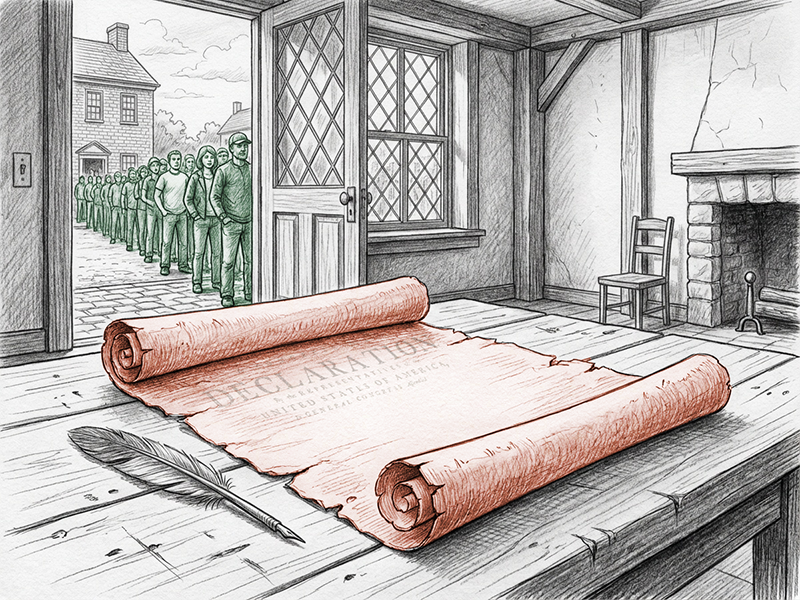
Most Americans can quote the beginning of the Declaration of Independence. “We hold these truths to be self-evident, that all men are created equal, that they are endowed by their Creator with certain unalienable Rights, that among these are Life, Liberty and the pursuit of Happiness. That to secure these rights, Governments are instituted among Men, deriving their just powers from the consent of the governed.” We know these words the way we know the Pledge of Allegiance — by rhythm and repetition, without always stopping to consider what they actually mean.
But there is a sentence in the Declaration that most people have either forgotten or never fully absorbed. It comes right after the famous part. And it may be the most radical thing ever written into a founding document of any nation in human history:
“That whenever any Form of Government becomes destructive of these ends, it is the Right of the People to alter or to abolish it, and to institute new Government, laying its foundation on such principles and organizing its powers in such form, as to them shall seem most likely to effect their Safety and Happiness.”
Read that again slowly.
The founders did not just declare independence from Britain. They built into the philosophical foundation of this country a permanent, explicit right — one might even say a duty — for the people to dismantle their government and rebuild it when that government stops serving them.
They meant it. And understanding why they wrote it tells us something essential about where we are right now.
The World They Were Living In
To understand why Jefferson wrote those words, you have to understand what the colonists had actually lived through in the thirteen years leading up to July 4, 1776. This was not a revolution that happened suddenly. It was the result of patient escalation — one grievance answered with another grievance, one petition ignored, then another — until a critical mass of colonists concluded that the British government had no intention of ever treating them as equal subjects under English law.
1763 — The Starting Point
The story begins not with a tax but with a war. Britain’s victory over France in the French and Indian War (1754–1763) left the Crown with an enormous national debt and a vastly expanded North American territory to defend. Parliament decided the colonies should help pay for it (U.S. Department of State, Office of the Historian, n.d.a).
The Royal Proclamation of 1763 also drew a geographic boundary along the Appalachian Mountains, forbidding colonists from settling on lands recently acquired from France — frustrating settlers and land speculators who had expected access to those territories (American Revolution Museum, 2025).
1764–1765 — Taxation Without Representation
In 1764, Parliament passed the Sugar Act, imposing duties on sugar and molasses imported from non-British sources. It was the first law specifically designed to raise revenue directly from the colonies (U.S. Department of State, Office of the Historian, n.d.a).
Then came the Stamp Act of March 22, 1765 — the first direct internal tax on the colonists. It required a government-issued stamp on every piece of printed paper: legal documents, newspapers, pamphlets, even playing cards (Gilder Lehrman Institute, n.d.a). Unlike previous trade regulations, this was explicitly a tax imposed without the consent of any colonial legislature, and it applied to every colony (National Park Service, n.d.a).
“Taxation without representation” was not a slogan invented for bumper stickers. It was a genuine constitutional argument: under English law, a British subject’s property could not be taken in the form of taxes without the consent of his elected representatives. The colonies had no seats in Parliament. Parliament, the colonists argued, had no right to tax them (Britannica, 2024a).
Also in 1765, Parliament passed the Quartering Act, requiring colonial assemblies to provide housing, food, and supplies for British troops stationed in their towns — at colonial expense, without the assemblies’ consent. When the New York Assembly refused to comply, Parliament responded by ordering it suspended until it did (Britannica, 2024b).
The colonists responded to the Stamp Act with organized protest. Nine of the thirteen colonies sent delegates to the Stamp Act Congress in October 1765, which issued a formal Declaration of Rights and Grievances appealing to Parliament and the King. It was respectful. It was firm. It was ignored (Gilder Lehrman Institute, n.d.a).
1766 — Repeal, Then Defiance
Under significant economic pressure from British merchants who were losing money from colonial boycotts, Parliament repealed the Stamp Act in March 1766. The colonists celebrated. Their peaceful resistance had worked.
Then Parliament immediately passed the Declaratory Act, asserting its authority to legislate for the colonies “in all cases whatsoever” — making clear that the repeal was a tactical retreat, not an acknowledgment of any legitimate colonial rights (National Archives UK, n.d.). The message was unmistakable: we will do what we want, when we want.
1767–1770 — Escalation
In the summer of 1767, Parliament passed the Townshend Acts, imposing new import duties on glass, lead, paint, paper, and tea. The revenue would be used, pointedly, to pay the salaries of royal governors and judges in the colonies — making those officials financially independent of the colonial assemblies that had previously used salary control as a check on executive power (Britannica, 2024b). Again the colonists boycotted British goods. Again tensions rose.
On March 5, 1770, British soldiers stationed in Boston — a city that increasingly felt like an occupied territory — fired into a crowd of colonists after a confrontation that had been building for months. Five colonists were killed. The event became known as the Boston Massacre (Britannica, 2024c).
That same day, unaware of the massacre, Parliament partially backed down — repealing most of the Townshend duties but deliberately keeping the tax on tea, specifically to assert Parliament’s continued right to tax the colonies (Britannica, 2024b).
1773 — The Breaking Point
The Tea Act of 1773 was designed to bail out the financially troubled British East India Company by allowing it to sell tea directly to the colonies — while still maintaining the hated tea duty. To the colonists, it was both an economic attack on local merchants and a renewed constitutional provocation (National Archives UK, n.d.).
On the night of December 16, 1773, members of the Sons of Liberty boarded three ships in Boston Harbor and dumped 342 chests of East India Company tea into the water. The Boston Tea Party was not an impulsive act of vandalism. It was a calculated, organized political protest — and the colonists knew it would have consequences (History.com, 2025b).
1774 — The Intolerable Acts and the First Continental Congress
Parliament’s response was swift and severe. In 1774, it passed a series of laws the colonists called the Intolerable Acts. The Boston Port Act closed Boston Harbor entirely until the destroyed tea was paid for. The Massachusetts Government Act stripped Massachusetts of self-governance, replacing elected officials with Crown appointees. The Administration of Justice Act allowed royal officials accused of crimes to be tried in Britain rather than in the colonies. A new Quartering Act extended British authority to quarter troops in occupied dwellings (Britannica, 2024d).
In September 1774, delegates from twelve of the thirteen colonies convened at the First Continental Congress in Philadelphia. They issued the Declaration and Resolves, asserting colonial rights under English law, organized a sweeping economic boycott of British goods, and agreed to reconvene in May 1775 if their grievances remained unaddressed (U.S. Department of State, Office of the Historian, n.d.b).
They did remain unaddressed.
1775 — War, and One Last Attempt at Peace
In April 1775, British troops marched on Lexington and Concord, Massachusetts, to seize colonial weapons stores. Colonial militiamen fired back. The Revolutionary War had begun (National Park Service, n.d.b).
Even then, the Second Continental Congress made one final attempt at reconciliation. On July 5, 1775, Congress adopted the Olive Branch Petition, a formal appeal to King George III drafted primarily by John Dickinson, affirming colonial loyalty to the Crown and seeking a peaceful resolution. The petition was presented to the British Colonial Secretary on September 1. The King refused to receive it on the throne, and no answer was given. He proceeded to declare the colonies in a state of open rebellion (National Park Service, n.d.c).
By the time Jefferson sat down to write the Declaration in June 1776, the war had been underway for more than a year. British troops had bombarded and burned colonial towns. The King had contracted to hire Hessian mercenaries to fight his own subjects on American soil. Thomas Paine’s Common Sense, published in January 1776, had made the case for independence in plain language and circulated widely across the colonies (U.S. Department of State, Office of the Historian, n.d.a).
There was no more room for petition. Jefferson was not writing a philosophical treatise. He was writing a legal indictment — and the case had been building for thirteen years.
The Indictment
The Declaration of Independence is, at its core, a legal document. Historians have described it as a prosecutor’s opening statement — a formal indictment of King George III designed to prove to the world that the colonists had exhausted every peaceful option before taking up arms (History.com, 2025; Constitution Center, n.d.).
More than half of the Declaration’s text consists of 27 specific grievances against the King. They are not vague complaints. They are documented allegations:
He had refused to approve laws “most wholesome and necessary for the public good.” He had dissolved colonial legislatures for opposing his authority. He had made judges dependent on his will alone — appointing them, setting their salaries, and subjecting them to his direction. He had stationed standing armies in civilian homes without the consent of the legislatures. He had cut off colonial trade. He had imposed taxes without consent. He had denied the right to trial by jury. He had sent mercenary armies “to compleat the works of death, desolation and tyranny” (National Archives, n.d.).
The grievances culminated in a single conclusion: “A Prince, whose character is thus marked by every act which may define a Tyrant, is unfit to be the ruler of a free People” (National Archives, n.d.).
Crucially, the Declaration also noted that the colonists had not acted impulsively. Jefferson wrote that “in every stage of these Oppressions, We have Petitioned for Redress, in the most humble terms” and that “Our repeated Petitions have been answered only by repeated injury” (National Archives, n.d.). The alter-or-abolish clause was not a call to revolutionary violence at the first sign of political displeasure. It was a last resort, invoked only after years of documented abuse and exhausted alternatives.
Where the Ideas Came From
Jefferson did not invent the idea that people have the right to overthrow a government that fails them. He was drawing on a century of Enlightenment political philosophy — ideas that had been debated by scholars, theologians, and political theorists across Europe and that the founders had studied deeply.
The most direct intellectual ancestor is John Locke, the English philosopher whose Second Treatise of Government (1689) Jefferson called one of the foundational texts of political thought. Locke argued that governments exist by a social contract — an agreement between the governed and their government in which people surrender certain freedoms in exchange for the protection of their natural rights. When a government breaks that contract by becoming tyrannical, Locke wrote, the people are released from their obligation to obey it and retain the right to replace it (Historical Society of the New York Courts, n.d.).
Jefferson himself described the Declaration not as an original philosophical invention but as an expression of ideas already widely held. In a letter to Henry Lee in 1825, he wrote that the Declaration’s purpose was “not to find out new principles, or new arguments, never before thought of” but “to place before mankind the common sense of the subject, in terms so plain and firm, as to command their assent” (Jefferson, 1825, as cited in Bill of Rights Institute, n.d.). The ideas were in the air. Jefferson gave them their most precise and enduring expression.
The Constitution Center puts it plainly: the preamble to the Declaration “contains the entire theory of American government in a single, inspiring passage” — including the right of the majority of people to “alter and abolish” their government whenever it threatened to undermine the rights it was created to protect (Constitution Center, n.d.).
What “Alter or Abolish” Actually Means
It is worth being precise about what Jefferson wrote — and what he did not write.
The Declaration does not say the people have the right to tear down their government whenever they are unhappy with an election result. Jefferson anticipated that objection directly. Immediately after the alter-or-abolish clause, he wrote:
“Prudence, indeed, will dictate that Governments long established should not be changed for light and transient causes; and accordingly all experience hath shewn, that mankind are more disposed to suffer, while evils are sufferable, than to right themselves by abolishing the forms to which they are accustomed.”
Translation: Don’t do this casually. Human beings are patient. They endure a lot before they act. The right to alter or abolish government is reserved for when the pattern of abuse is clear, sustained, and deliberate — when it reveals, as Jefferson wrote, “a design to reduce them under absolute Despotism” (National Archives, n.d.).
What the founders were describing was not revolution as a first resort. It was revolution as a last resort — after petitions, after elections, after every peaceful mechanism of accountability had been tried and had failed.
The mechanism they preferred — and the one they built into the Constitution — was democratic accountability. Elections. Separation of powers. Checks and balances. A free press. The right to petition. The amendment process. The founders created these structures specifically so that the people would have peaceful tools for holding government accountable and changing course when necessary.
The alter-or-abolish clause exists as the ultimate backstop — the acknowledgment that if all those peaceful mechanisms fail, the people retain the sovereign right to rebuild their government from the ground up. It is not a loophole. It is the foundation.
Why This Still Matters
The Declaration of Independence was adopted on July 4, 1776 — 250 years ago this year. The grievances against King George III are historical. The Hessian mercenaries are gone. The Stamp Act was repealed centuries ago.
But the principles Jefferson articulated are not historical. They are the operating theory of American democracy, as relevant today as they were in 1776.
Governments derive their just powers from the consent of the governed. When they stop serving the people they were created to protect, the people have the right — and the responsibility — to change them.
The founders built peaceful mechanisms for doing exactly that: elections, accountability, civic engagement, constitutional amendment. Those mechanisms are available to us. They require participation to function. An electorate that does not vote, does not engage, does not hold officials accountable, and does not demand better from its government is — whether it realizes it or not — surrendering the very right Jefferson spent 17 days in a Philadelphia rented room writing into the founding charter of this country.
Jefferson was not writing for the colonists of 1776. He was writing, as he put it, to “place before mankind the common sense of the subject.” He was writing for every generation that would inherit this experiment in self-governance.
He was writing for us.
References
American Revolution Museum. (2025). Season of independence timeline. https://www.amrevmuseum.org/season-of-independence-timeline
Bill of Rights Institute. (n.d.). Thomas Jefferson and the Declaration of Independence. https://billofrightsinstitute.org/essays/thomas-jefferson-and-the-declaration-of-independence/
Britannica. (2024a). Stamp Act. Encyclopaedia Britannica. https://www.britannica.com/event/Stamp-Act-Great-Britain-1765
Britannica. (2024b). Townshend Acts. Encyclopaedia Britannica. https://www.britannica.com/event/Townshend-Acts
Britannica. (2024c). Boston Massacre. Encyclopaedia Britannica. https://www.britannica.com/event/Boston-Massacre
Britannica. (2024d). Intolerable Acts. Encyclopaedia Britannica. https://www.britannica.com/event/Intolerable-Acts
Constitution Center. (n.d.a). The Declaration, the Constitution, and the Bill of Rights. National Constitution Center. https://constitutioncenter.org/the-constitution/white-papers/the-declaration-the-constitution-and-the-bill-of-rights
Constitution Center. (n.d.b). The Declaration’s grievances against the King. National Constitution Center. https://constitutioncenter.org/essays/the-declarations-grievances-against-the-king
Gilder Lehrman Institute of American History. (n.d.a). The Stamp Act, 1765. https://www.gilderlehrman.org/history-resources/spotlight-primary-source/stamp-act-1765
Gilder Lehrman Institute of American History. (n.d.b). Annotated grievances. https://www.gilderlehrman.org/declaration-independence/annotated/grievances
Heritage Foundation. (n.d.). Grievances. In The essential Declaration of Independence. https://www.heritage.org/the-essential-declaration-independence/grievances
Historical Society of the New York Courts. (n.d.). Declaration of Independence (1776). https://history.nycourts.gov/democracy-teacher-toolkit/american-revolution/declaration-of-independence/
History.com. (2025a). The Declaration of Independence was also a list of grievances. https://www.history.com/articles/declaration-of-independence-grievances
History.com. (2025b). Boston Tea Party. https://www.history.com/articles/boston-tea-party
Jefferson, T. (1776). Declaration of Independence [Transcription]. National Archives. https://www.archives.gov/founding-docs/declaration-transcript
National Archives (UK). (n.d.). Boston Tea Party. The National Archives. https://www.nationalarchives.gov.uk/education/resources/boston-tea-party/
National Archives (US). (n.d.). Declaration of Independence: How did it happen? https://www.archives.gov/founding-docs/declaration/how-did-it-happen
National Park Service. (n.d.a). Britain begins taxing the colonies: The Sugar and Stamp Acts. https://www.nps.gov/articles/000/sugar-and-stamp-acts.htm
National Park Service. (n.d.b). Timeline of the American Revolution. https://www.nps.gov/subjects/americanrevolution/timeline.htm
National Park Service. (n.d.c). The Olive Branch Petition. https://www.nps.gov/articles/000/the-olive-branch-petition.htm
U.S. Department of State, Office of the Historian. (n.d.a). Parliamentary taxation of colonies, international trade, and the American Revolution, 1763–1775. https://history.state.gov/milestones/1750-1775/parliamentary-taxation
U.S. Department of State, Office of the Historian. (n.d.b). The Continental Congress, 1774–1781. https://history.state.gov/milestones/1776-1783/continental-congress
U.S. Department of State, Office of the Historian. (n.d.c). The Declaration of Independence, 1776. https://history.state.gov/milestones/1776-1783/declaration
Actually Govern is a project of Whimsy Books LLC d/b/a Actually Govern. We are non-partisan, unaffiliated with any political party, and committed to civic education over political tribalism.