
I keep coming back to the same realization as I dig through the data: the numbers are never the surprising part. What surprises me — what genuinely stops me cold — is how clearly Americans see the problem and how completely the system ignores them.
Last time, we talked about term limits and the 87% of Americans demanding something Congress refuses to give them. Today I want to talk about another number that keeps me thinking — the one that sits underneath almost every other problem in American politics like a foundation crack running through the whole building.
Here is the number:
77% of Americans say there should be limits on the amount of money individuals and organizations can spend on political campaigns.
Not 77% of Democrats. Not 77% of Republicans. 77% of Americans — including 85% of Democrats and 71% of Republicans (Pew Research Center, 2018). In Pew’s broader 2023 study, 72% of adults reiterated this position, with comparable majorities across both parties (Pew Research Center, 2023a).
And in 2024, voters were asked to rank their policy priorities. Reducing the influence of money in politics came in third — behind only the economy and defending against terrorism, but ahead of health care, immigration, and education. Sixty-five percent of Democrats and 60% of Republicans called it a top priority (Pew Research Center, 2024).
This is not a fringe issue. This is one of the most broadly supported positions in American politics.
And the system’s response? Sixteen billion dollars spent on the 2024 election — the most expensive in American history (OpenSecrets, 2024a).
Follow the Money
Let’s put $16 billion in perspective.
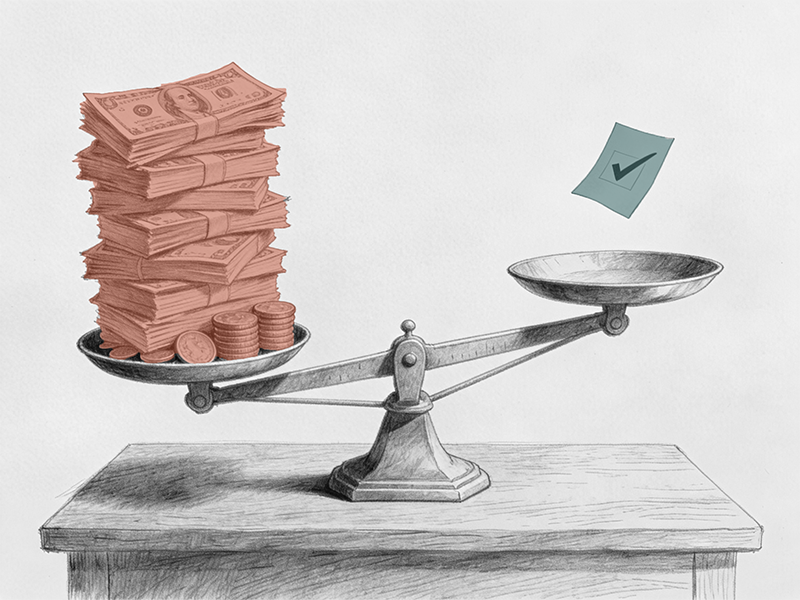
In the 2024 election cycle, the top 1% of all donors accounted for 50% of all money raised. The top 100 individual donors contributed $599 million — 7% of every dollar raised in the entire federal election. Meanwhile, all small donors giving under $200 accounted for just 16% of total fundraising (OpenSecrets, 2024a).
Read that again. The top 100 people gave more than the millions of Americans who donated small amounts combined.
Outside spending — money spent by groups like super PACs to independently support or attack candidates — shattered records at $4.5 billion. More than $1 billion of that came from “dark money” sources, meaning organizations that do not disclose their donors (OpenSecrets, 2024b). These are people spending hundreds of millions of dollars to influence who represents you, and you are not allowed to know who they are.
And it works. According to Pew, 84% of Americans say “special interest groups and lobbyists have too much say in what happens in politics” (Pew Research Center, 2023a). Eighty-five percent say the cost of campaigns makes it hard for good people to run for office. Eighty-one percent say members of Congress do a bad job of keeping their personal financial interests separate from their work (Pew Research Center, 2023a).
Americans are not confused about what is happening. They can see it. They just have not been given a mechanism to stop it.
The Founders Saw This Coming
If there is one thread that runs through everything the founders wrote, it is this: they were terrified of concentrated power. They debated it endlessly. They built an entire system of government around preventing it. And concentrated wealth was near the top of their list of concerns.
James Madison — the architect of the Constitution — defined government corruption not merely as bribery but as any policy that promoted private interests at the expense of the public good. At the Constitutional Convention, he argued that “the power of all corporations ought to be limited” and warned specifically against “the indefinite accumulation of property” (Levin, 2018). He understood that unchecked wealth would inevitably seek political influence, and that political influence would inevitably serve the interests of wealth.
Madison wrote in Federalist No. 10 that the most dangerous threat to a republic was faction — a group of citizens driven by passions or interests “adverse to the rights of other citizens, or to the permanent and aggregate interests of the community” (Madison, 1787). He was describing, almost exactly, the modern super PAC.
George Mason, who helped draft the Virginia Declaration of Rights and influenced the Bill of Rights, refused to sign the Constitution in part because he believed it did not do enough to prevent the concentration of power among the wealthy. He warned that without proper safeguards, the new government would produce “a monarchy, or a corrupt, tyrannical aristocracy” (Mason, 1787).
These were not abstract fears. The founders had watched the British Parliament operate as a system in which seats were openly bought and sold, where wealthy landowners dictated policy, and where the interests of ordinary people were an afterthought. They designed an entire form of government to prevent exactly what is happening now.
How We Got Here
For most of American history, there were laws on the books limiting how much money could flow into elections. They were imperfect, but they existed.
The Tillman Act of 1907 banned corporate contributions to federal campaigns. The Federal Election Campaign Act of 1971 established disclosure requirements and contribution limits. The Bipartisan Campaign Reform Act of 2002 — commonly known as McCain-Feingold — restricted “soft money” contributions to political parties and limited corporate-funded advertising near elections.
Then, in 2010, the Supreme Court issued its ruling in Citizens United v. Federal Election Commission.
In a 5–4 decision, the court struck down restrictions on independent political spending by corporations and unions, ruling that such limits violated the First Amendment’s protection of free speech (Citizens United v. FEC, 2010). The majority opinion, written by Justice Anthony Kennedy, argued that the government could not restrict political speech based on the identity of the speaker — whether that speaker was an individual or a corporation.
Justice John Paul Stevens, in his dissent, warned that the ruling “threatens to undermine the integrity of elected institutions across the Nation” and represented “a rejection of the common sense of the American people, who have recognized a need to prevent corporations from undermining self-government since the founding” (Citizens United v. FEC, 2010, Stevens, J., dissenting).
The effects were immediate and dramatic. Before Citizens United, outside spending in the 2008 election totaled $574 million. By 2012, it had surged to $1.3 billion. By 2024, it reached $4.5 billion (OpenSecrets, 2024b). Dark money — political spending from sources that do not disclose their donors — went from negligible to over $1 billion in a single election cycle (OpenSecrets, 2024b). The creation of super PACs, which can raise and spend unlimited amounts, followed directly from the Citizens United logic when a federal appeals court applied it in SpeechNow.org v. FEC later that same year.
In the 2022 midterms alone, just 21 of the wealthiest donor families contributed $783 million, and billionaires provided 15% of all federal election financing (Brennan Center for Justice, 2025). By 2024, billionaire spending in elections had multiplied by a factor of 163 since Citizens United, with over 80% of that spending flowing through channels that were prohibited before the ruling (Roosevelt Institute, 2025).
The late Justice Ruth Bader Ginsburg called Citizens United the worst ruling of her time on the court (Brennan Center for Justice, 2025).
She was not alone in that assessment.
What the People Want — and What They Are Doing About It
Americans have responded to this with remarkable clarity and consistency.
A 2025 YouGov poll commissioned by Issue One found that nearly 8 in 10 Americans agree that anti-corruption rules strengthen democracy, while just 1 in 10 believe they infringe on free speech. Nearly 8 in 10 also agreed that large expenditures by wealthy donors give rise to corruption (Issue One/YouGov, 2025, as reported by OpenSecrets). An October 2024 survey by American Promise found that 82% of registered voters view money in politics as a threat to democracy, and 77% support a constitutional amendment to allow reasonable limits on election spending (American Promise/Citizen Data, 2024).
This is not a close call. The American public has reached something approaching consensus: the current system is broken, and they want it fixed.
And like term limits, citizens are not waiting for Congress to act.
Twenty-three states have passed resolutions calling for a constitutional amendment to overturn Citizens United and restore the ability of states and Congress to set reasonable limits on political spending (Free Speech For People, 2025). These resolutions have passed in red states and blue states alike. American Promise, a cross-partisan organization, is driving adoption of what they call the For Our Freedom Amendment — a proposed 28th Amendment that would restore the power to regulate election spending. Seven ballot initiatives in states across the country have passed with overwhelming voter support, and none have ever lost (American Promise, 2025).
In 2014, a majority of the U.S. Senate voted for the Democracy for All Amendment, which would have given Congress and the states explicit authority to regulate campaign spending. The amendment did not receive the two-thirds supermajority required, but it received more votes in favor than against (Public Citizen, 2024). It was the first time in over a decade that either chamber of Congress had voted on a constitutional amendment related to campaign finance.
Like the Article V path for term limits, this is a long road. Constitutional amendments are supposed to be hard. But the direction is clear, and the momentum is building.
Why This Matters More Than You Think
Money in politics is not just one issue among many. It is the issue underneath all the other issues.
Why does Congress not act on term limits when 87% of Americans support them? Because career incumbents rely on the fundraising advantages of incumbency. Why does prescription drug pricing remain a source of frustration for millions? Because the pharmaceutical industry spent $374 million on lobbying in 2023 alone (OpenSecrets, n.d.). Why do broadly popular policies — on everything from background checks to infrastructure to childcare — stall or die in committee? Because the people funding campaigns have different priorities than the people voting in them.
When 63% of Americans believe that most elected officials ran for office to make money — not to serve the public — that is not cynicism (Pew Research Center, 2023b). That is pattern recognition.
The founders understood this. Madison did not just worry about faction in the abstract — he worried specifically about what would happen when wealth captured the machinery of government. That is not a left-wing talking point or a right-wing talking point. It is a structural analysis that 77% of the country has arrived at independently.
The Bottom Line
The founders built a government designed to serve the people. For more than a century, laws existed to prevent concentrated wealth from drowning out the voices of ordinary citizens. In 2010, the Supreme Court swept those protections away. Since then, election spending has exploded, dark money has become the norm, and public trust in government has collapsed to historic lows.
And yet — 77% of Americans still agree on the solution. Twenty-three states have already acted. The momentum for a constitutional amendment is real and growing.
This is not about left or right. This is about whether your voice counts as much as someone who can write a $100 million check. Right now, it does not. The data is clear. The founders warned us. And the American people — across every party line — have been saying the same thing for years.
The only people who benefit from the current system are the people the current system was built to serve. And it was not built to serve you.
References
American Promise/Citizen Data. (2024, October 30). New survey: Voters view the influence of money in politics as a threat to democracy, want constitutional amendment to limit spending. American Promise. https://americanpromise.net/new-survey-voters-want-constitutional-amendment-to-limit-spending/
Brennan Center for Justice. (2025, January 21). Fifteen years later, Citizens United defined the 2024 election. https://www.brennancenter.org/our-work/research-reports/fifteen-years-later-citizens-united-defined-2024-election
Citizens United v. Federal Election Commission, 558 U.S. 310 (2010).
Free Speech For People. (2025). State resolutions in support of amending the Constitution. https://freespeechforpeople.org/state-resolutions-support-amending-constitution/
Issue One/YouGov. (2025). National poll on money in politics and anti-corruption rules. As reported by OpenSecrets. https://www.opensecrets.org/news/2025/10/most-americans-see-unlimited-election-spending-as-a-threat-to-democracy-poll/
Levin, A. (2018). James Madison, Citizens United, and the constitutional problem of corruption. American University Law Review, 68(5), 1485–1539. https://digitalcommons.wcl.american.edu/cgi/viewcontent.cgi?article=2165&context=aulr
Madison, J. (1787). Federalist No. 10. In A. Hamilton, J. Madison, & J. Jay, The Federalist Papers. Library of Congress. https://guides.loc.gov/federalist-papers/full-text
Mason, G. (1787). Objections to the proposed federal Constitution. Teaching American History. https://teachingamericanhistory.org/document/objections-of-george-mason-to-proposed-federal-constitution/
OpenSecrets. (2024a, October 8). Total 2024 election spending projected to exceed previous record. https://www.opensecrets.org/news/2024/10/total-2024-election-spending-projected-to-exceed-previous-record/
OpenSecrets. (2024b, November). Outside spending on 2024 elections shatters records, fueled by billion-dollar dark money infusion. https://www.opensecrets.org/news/2024/11/outside-spending-on-2024-elections-shatters-records-fueled-by-billion-dollar-dark-money-infusion/
OpenSecrets. (n.d.). Lobbying data overview. https://www.opensecrets.org/federal-lobbying
Pew Research Center. (2018, May 8). Most Americans want to limit campaign spending, say big donors have greater political influence. https://www.pewresearch.org/short-reads/2018/05/08/most-americans-want-to-limit-campaign-spending-say-big-donors-have-greater-political-influence/
Pew Research Center. (2023a, September 19). Americans’ dismal views of the nation’s politics. https://www.pewresearch.org/politics/2023/09/19/americans-dismal-views-of-the-nations-politics/
Pew Research Center. (2023b, October 23). 7 facts about Americans’ views of money in politics. https://www.pewresearch.org/short-reads/2023/10/23/7-facts-about-americans-views-of-money-in-politics/
Pew Research Center. (2024, February 29). Americans’ top policy priority for 2024: Strengthening the economy. https://www.pewresearch.org/politics/2024/02/29/americans-top-policy-priority-for-2024-strengthening-the-economy/
Public Citizen. (2024). Momentum builds for overturning Citizens United: Timeline of key events. https://www.citizen.org/article/constitutional-amendment-timeline/
Roosevelt Institute. (2025). Citizens United and the decline of US democracy: Assessing the decision’s impact 15 years later. https://rooseveltinstitute.org/publications/citizens-united-15-years-later/
SpeechNow.org v. Federal Election Commission, 599 F.3d 686 (D.C. Cir. 2010).
Actually Govern is a project of Whimsy Books LLC d/b/a Actually Govern. We are non-partisan, unaffiliated with any political party, and committed to civic education over political tribalism.